BYOMA Review: Is It Worth It? My Take After Three Months
Today I’m sharing everything I think about BYOMA after buying seven of their products and using them daily for three months (actually…I think we’re up to four months at this point). This BYOMA review is not sponsored. I paid for every product in it myself (nothing here was gifted or sent to me by the brand). This post may contain affiliate links.
My cute little sister has been deep in Korean skincare for a couple of years now, and she told me she’d started using the BYOMA Hydrating Milky Toner in the morning under her makeup. She is the one with beautiful skin (truly, when I see her skin I wonder how we’re related because the 6 year age gap doesn’t account for the difference). I assumed it was a K-beauty brand because that’s most of what she’s recommended, ordered the toner, and only later found out I had the country wrong by about five thousand miles.
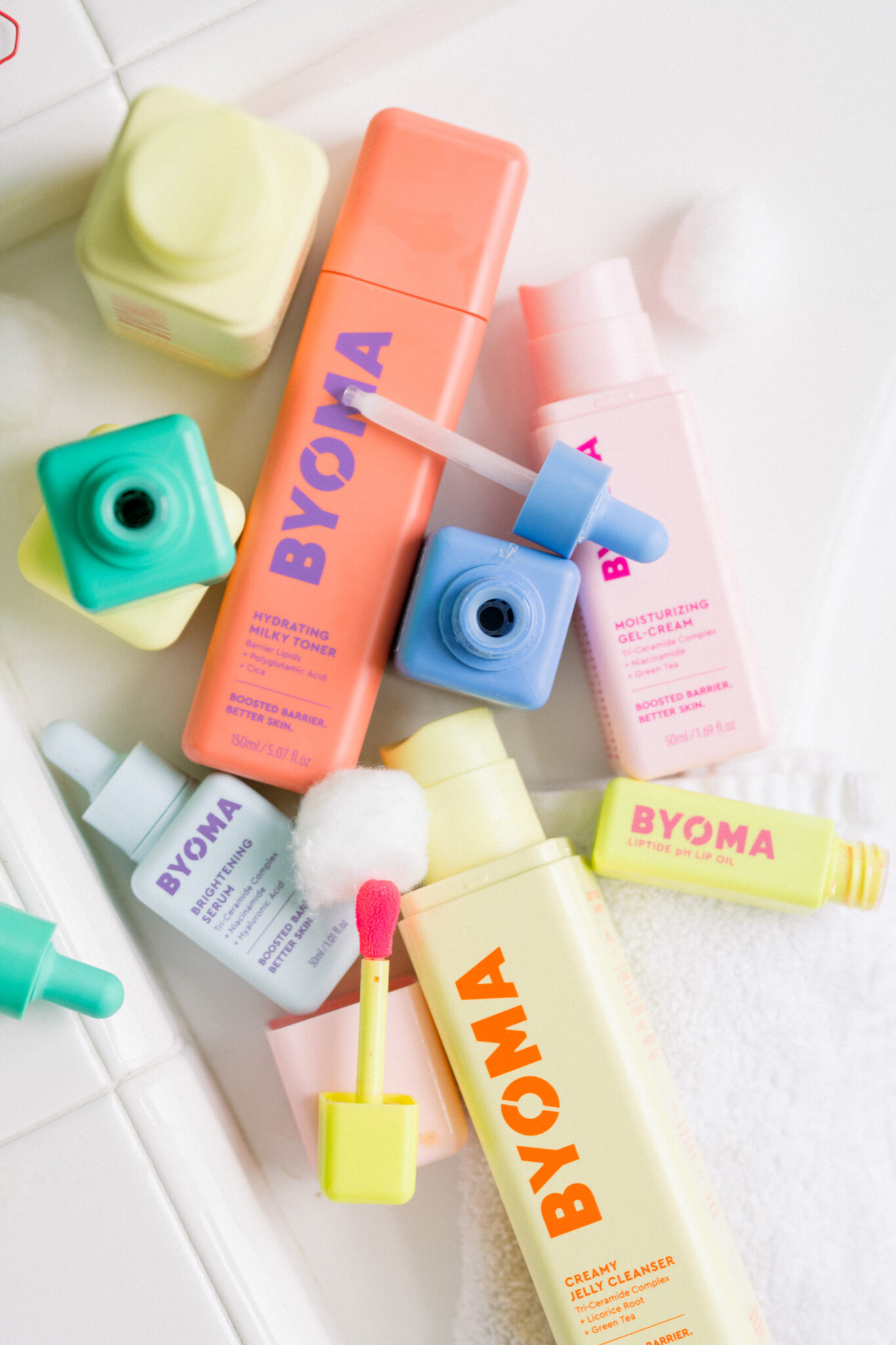
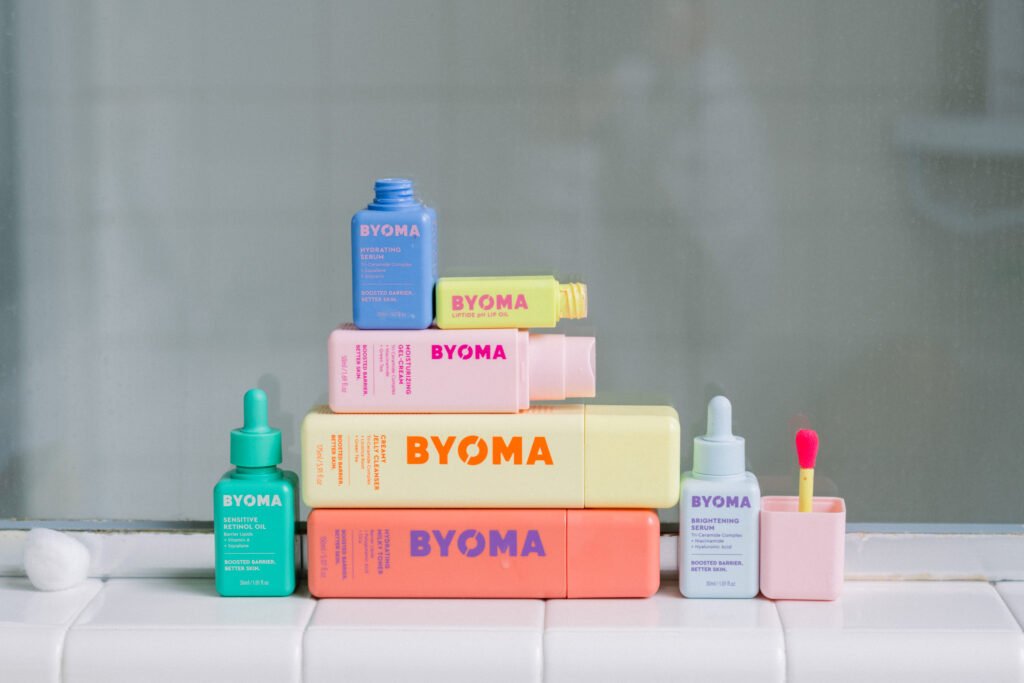
In the last few months I’ve worked my way through the cleanser, two serums, the moisturizer, the milky toner (obviously), the lip oil, and their retinol oil. I’ve built most of my routine around it for three months, testing how everything works. The price point is fantastic with everything sitting between $12 and $20. My whole order came to $75, and I’ve spent more than that on a single serum in the past.
So here’s the real question: is BYOMA actually good, or is it just very good at packaging? After three months I have a clear answer: three products I’ll absolutely rebuy (one I already have), one that was less exciting but fine, and one I’d tell you to skip if you’re over thirty. We’ll also get into the ones I’m buying for my tweens as their first skincare regimen.
What Is BYOMA? (And Is BYOMA Korean?)
No, BYOMA is not Korean. It’s Scottish. The brand launched in 2022 out of Future Beauty Labs in Glasgow, founded by Marc Elrick, whose company also makes Tan-Luxe and Isle of Paradise. In September 2025 the private equity firm Bansk Group took a majority stake, and Elrick stayed on as CEO with a minority position. Bansk also owns Amika and Eva NYC, so BYOMA is now sitting in a fairly serious portfolio.
I mention all of this because my sister and I both assumed it was K-beauty, and judging by how many people search that exact question every month, we are not alone. The packaging reads Korean. The pastel gradient, the barrier-first marketing, the milky textures. It is all borrowed from that playbook and borrowed well.
The whole brand is built around one idea: your skin barrier. Every product is formulated around what they call a Tri-Ceramide Complex, which is ceramide NP, cholesterol, and phytosphingosine. That’s not a made-up marketing trio. Those three are genuinely what your barrier is built from, and they show up high in the ingredient list on almost everything, not tucked at the bottom where they’d be doing nothing.
The other thing worth knowing before you order: almost the entire face line is fragrance-free. No parfum, no essential oils. I went through the ingredient lists on all seven of the products I bought, and only one had fragrance in it. At this price that’s rare, and it’s the reason I ended up recommending this brand to people with reactive skin.
Prices sit between $11.99 and $19.99, and you can find it at Target, Ulta, Sephora, Walmart, and CVS. You can also shop BYOMA on Amazon.
I ordered mine directly from BYOMA and paid $75 for six products against a $104.92 list price. They run 25% off when you buy four or more, and shipping is free over $40, so the discount does most of the work. If you’re going to try the brand at all, putting one order of four together is meaningfully cheaper than picking up a single thing at Target.
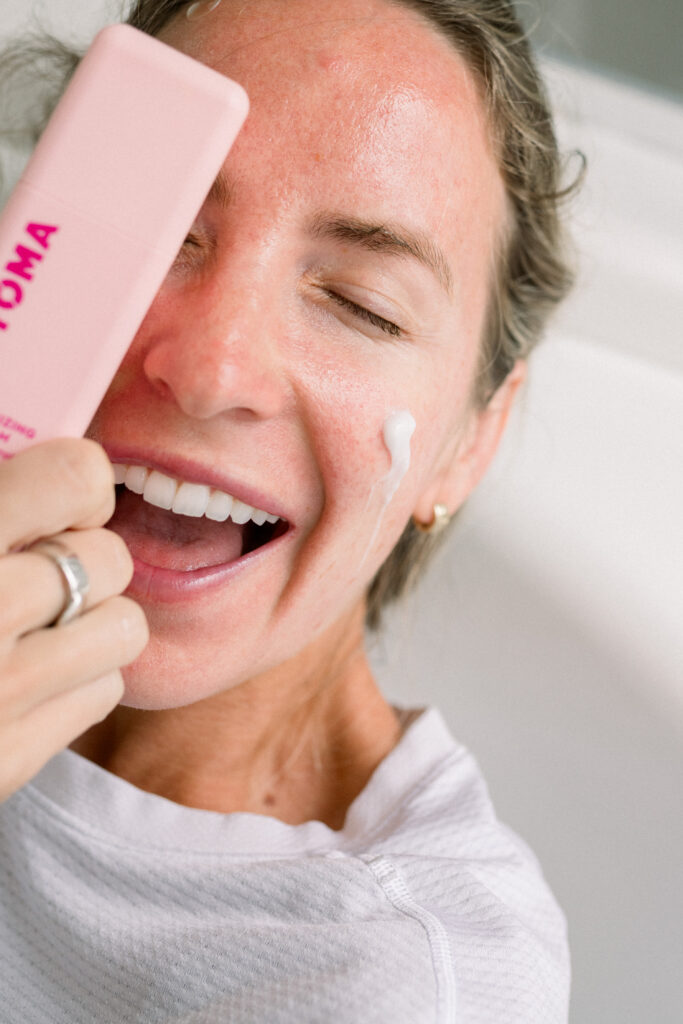
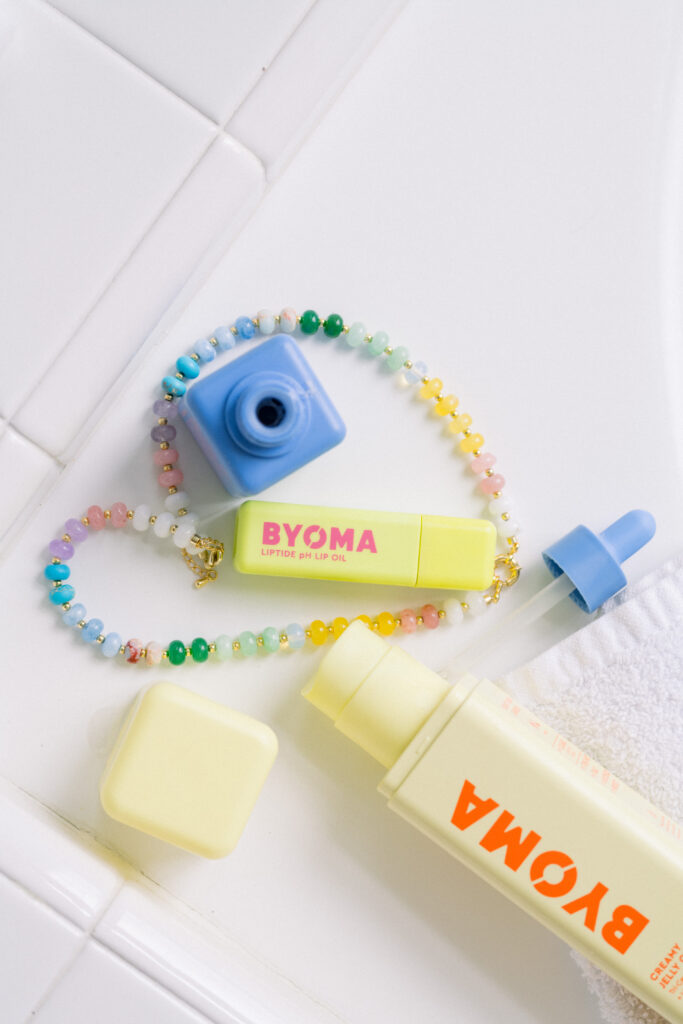
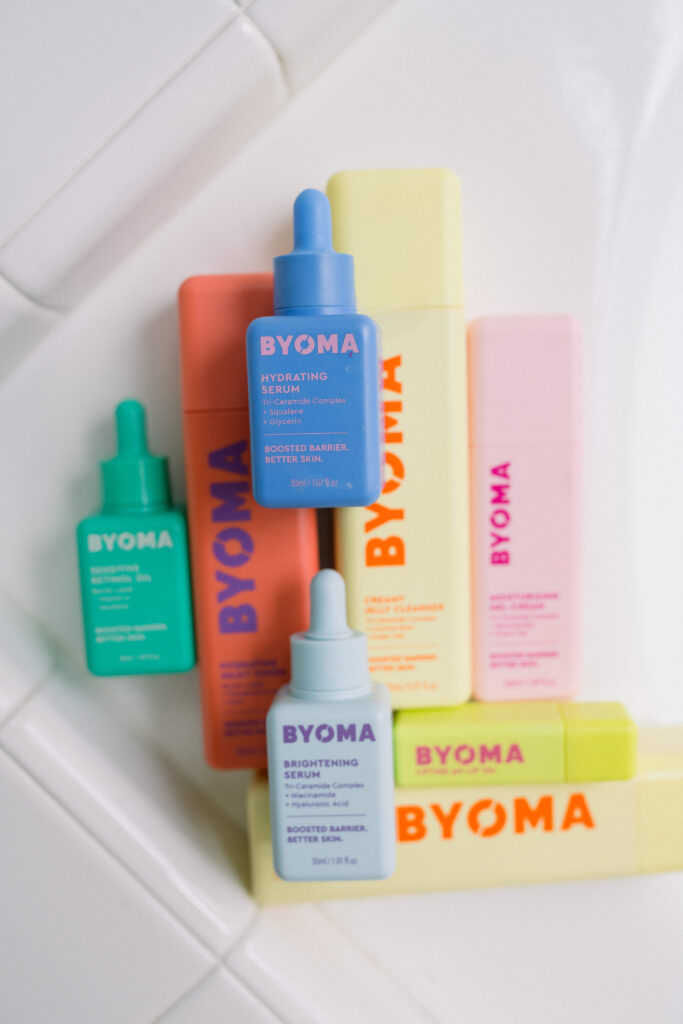
The BYOMA Products I Actually Bought and Used
I want to be clear about what this list is. These are the seven products that have been in my bathroom for two months, not the whole range. I’ve noted at the bottom what I haven’t tried.
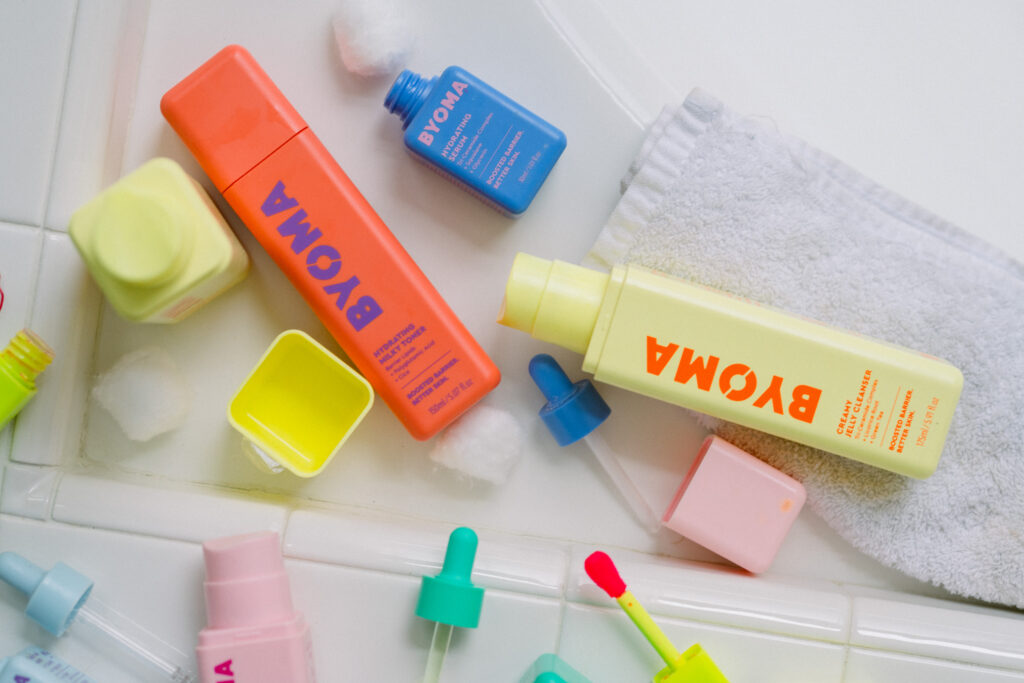
⭐ Favorite Overall: Hydrating Milky Toner ($14.99)
This is the one my sister recommended and it’s the one I’d repurchase first if I was starting over.
It’s not a toner in the old astringent sense. There’s no alcohol in it so there is nothing that strips. It’s a milky, slightly slippery hydrating layer that goes on after cleansing. It absorbs in about ten seconds without leaving anything tacky behind and works really well as a primer. I pour it into my palms and press it in rather than using a cotton pad like I would a traditional toner.
I use it morning and night. In the morning it goes on damp skin before anything else and helps my makeup sit well all day (why my sister recommended it in the first place).
Quality note: I use this twice a day, every day, which is more than I use anything else on this list. The formula is glycerin and polyglutamic acid and panthenol with the ceramide trio, plus a little gluconolactone, which is a very gentle exfoliating acid. Nothing in it stings, and there’s no fragrance.
What I love: It’s the easiest step. It layers under everything.
What to know: If you want a toner that does something dramatic, this isn’t it. It hydrates. It isn’t harsh or full of actives.
Creamy Jelly Cleanser ($12.99)
My favorite gentle everyday cleanser right now, and at $12.99 it’s cheaper than most of what I’ve used.
I use it at night as the second step of a double cleanse. First I take my makeup off with the Dew of the Gods Maui Glaze Dragon Fruit Oil Facial Cleanser that came in an Ipsy bag, then I go in with this. It is a thick jelly cleanser that turns a little milky while you’re lathering (and has very little foam).
You can tell this doesn’t have any harsh actives in it because your face doesn’t feel any different a minute afterwards. You know how will some masks for cleansers your skin feels tight or tingly? This one is very gentle and has none of that.
Quality note: There are mild surfactants in this (there’s licorice root and green tea in the formula along with the ceramides). Fragrance-free.
A confession: I don’t wash my face in the morning. I read something (or saw some Instagram reel more likely) about how washing your face in the morning strips all the natural moisture. If my skin feels like it needs something I’ll rinse with water before using the milky toner. I know that’s not what most routines tell you to do but we’re going with it for a bit.
Brightening Serum ($15.99)
You know when you look in the mirror and think “wow, I look tired”? This is how I’m feeling a lot of days and I always reach for this.
It’s niacinamide-led with a little ascorbic acid further down the list. It’s thin, absorbs fast, and doesn’t pill under sunscreen (which I thought it might at this low pirce point). If your skin looks dull and flat when you wake up, I would recommend trying this.
What to know: I also use a separate vitamin C from Amazon in the morning (although I finally went to the derm yesterday and she said to cut it out because its too much for my skin between that and the tretinoin at night). On a good morning I’ve been using both of these serums but, honestly, half the time I skip them both because I’m running a bit behind to one of the school drop offs. I’d say if you’re getting some positive benefits from even inconsistent use, that is a good endorsement.
Hydrating Serum ($15.99)
This is a great counterpart to the brightening serum and another one I’d rebuy. It feels like the serum version of the milky toner and is light and creamy.
This one is hyaluronic acid and the ceramide complex, and it helps retain moisture on your skin. I layer it at night under a moisturizer and every once in awhile use it in the morning, too. It doesn’t pill, it doesn’t sting, and it plays well with the retinol oil.
If you’re deciding between the two serums: brightening in the morning, hydrating at night. I own both and use both, and if you can only buy one, think about your own skin/ concerns and go from there.
Moisturizing Gel Cream ($14.99)
Okay this product is good it just wasn’t the right one for me to buy.
The gel cream is good. It’s a light, gel-textured moisturizer with niacinamide sitting sixth on the ingredient list, it absorbs quickly, it sits fine under sunscreen and makeup, and it’s fragrance-free. I have no complaints about it and I’ve used the almost whole bottle.
It’s also not doing it for me. I use it mostly in the morning, and at night I’ve been reaching for something thicker because at 35 my skin needs a little more than this light option.
If I were ordering again I’d try their Barrier+ Treatment ($17.99) for nighttime instead. I haven’t used it, so treat that as what I’d pick next instead of a recommendation. It’s built on the same ceramide base as the gel moisturizer but with shea butter, squalane and ectoin added. Its aimed at dry and sensitive skin (read: skin over the age of 30).
I still think this is a great product for someone else. For young skin, this would be a good morning and evening moisturizer. It’s light, it’s gentle, there’s nothing in it that a teenager’s skin needs to be protected from, and it costs $14.99. I would start my tweens on this if they needed a moisturizer.
What I love: Light, clean formula, no fragrance, absorbs fast.
What to know: If you’re over thirty and you like a rich night cream, this won’t be enough in the evenings.
Sensitive Retinol Oil ($19.99)
Full disclosure: I already use a prescription tretinoin twice a week, so I’m not the right person to tell you how strong this oil is and if it is going to irritate you. I’ve written before about starting prescription tretinoin through Dear Brightly, and once your skin has been through that, a gentler over-the-counter retinoid isn’t going to shock it.
With that said: I liked adding it in. It uses hydroxypinacolone retinoate rather than straight retinol, which is a gentler form, and it let me get a bit more retinoid benefit on the nights I’m not using my prescription without the peeling I’d get from doubling up on the strong stuff. It’s an oil, it’s fragrance-free, and a very small amount covers my whole face.
What to know: I didn’t notice anything dramatic, but I was already using a stronger version. If this is your first retinoid, retinoids generally cause some purging in the first few weeks (bring up some imperfections) before things settle, and you should start twice a week and build up rather than going nightly from the get go.
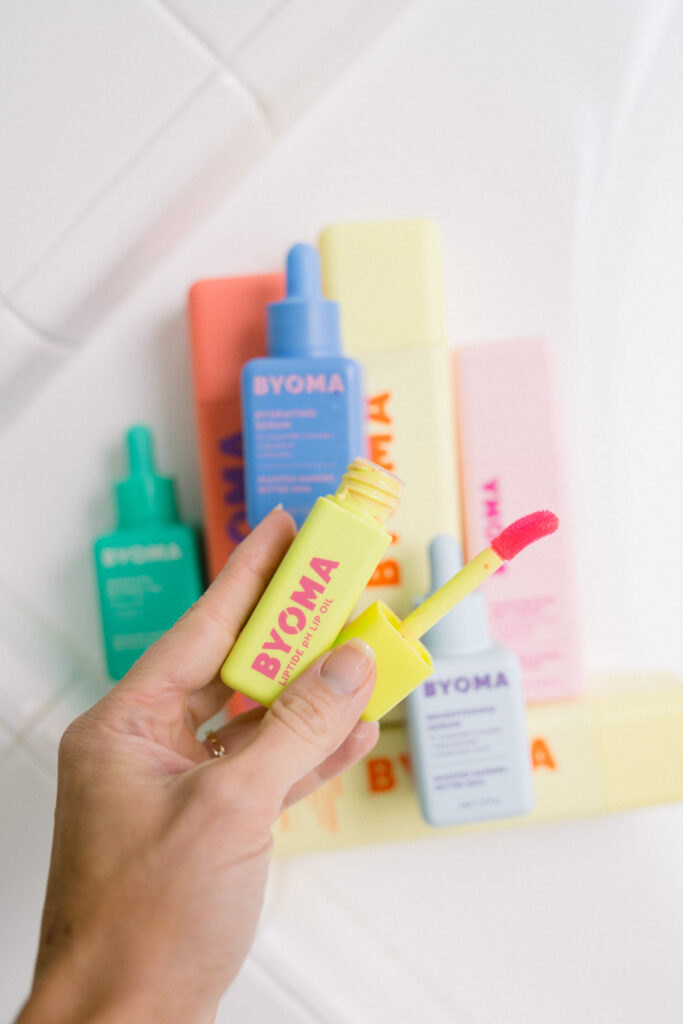
Liptide pH Lip Oil ($11.99)
This is the fun one!
It goes on clear and turns pink based on your skin’s pH, so the color is slightly different on everyone. It’s a nice, non-sticky formula and I mostly use it at night as a lip mask but will also throw it on during the day for a tiny bit of color, too (plus, it smells good).
My verdict: it’s a fun add-on, not a life-changer. If you’re already putting an order together, throw it in.
What to know: this is one of only two products in the BYOMA range that contains fragrance. The ingredient list has both Fragrance and Red 27 in it. That’s fine for most adults, and I’ve had no issue with it. But given that the rest of the line is deliberately fragrance-free, and given that this is exactly the product a nine-year-old is going to ask for, I just wanted to flag it for you.
What I Haven’t Tried Yet: The Sunscreen
I haven’t used the BYOMA Ultralight Face Fluid, but its next on my list
I’ve ordered it, and I’ll update this post once I’ve actually worn it for a hundred hours.
What I can tell you from the ingredient list is that it uses chemical filters, avobenzone, homosalate and octisalate, rather than mineral ones, and that it contains clove bud extract, which has a perfuming function. That makes it the second of the two products in the range that isn’t fragrance-free. If you specifically want a mineral sunscreen or a fully fragrance-free one, this isn’t going to be your pick. But, if you are of the opinion that the best sunscreen is the one you’ll actully use, I’ve heard great things about this one (especially for the price point).
Is BYOMA Good for Tweens and Kids?
This is the question I’m most interested in, because my kids are just starting to think about skincare. I’ve been quietly testing things and doing some research to see how and when we get started (without spendign $200 at sephora for a 10 year old).
To be clear, my kids haven’t used any of this yet. I bought it for me and have been using it for a few months. But I’ve been paying closer attention than I otherwise would have, because I know what’s coming.
Here’s where I’ve landed. If I were starting a nine to twelve year old on skincare tomorrow, I’d start with sunscreen, and I’d probably stop there for a while. Sunscreen does more for a kid’s skin over the next fifty years than everything else on the shelf combined, and if buying the sunscreenin a bright fun bottle gets them to put it on by themselves every morning, that is worth every penny to me.
After that, and only if they want it/ned it, a gentle cleanser and a light moisturizer. The BYOMA gel cream is a great option, and probably what I’ll start them with. It’s light, it’s simple and, it’s fragrance-free. The thing that makes it not quite enough for me at night is exactly what makes it right for an eleven-year-old.
What I would keep away from a tween:
- The Sensitive Retinol Oil. There is no version of a nine-year-old needing a retinoid.
- The Brightening Serum. Ascorbic acid and niacinamide on young skin can pose an irritation risk.
- Anything anti-aging. The collagen mask, the eye creams. A twelve-year-old does not have fine lines and I don’t want my kids to start looking for them (the exception to this might be a gentle collagen mask as part of a fun mother-daughter spa night)
- The Liptide lip oil: because of the fragrance and the red dye, we’ll skip this one.
In summary: BYOMA is a reasonable place for a tween to start, mostly because it’s inexpensive, fragrance-free, and formulated around barrier support rather than actives. Bonus points is that all the packaging is bright, happy, and fun.
My BYOMA Skincare Routine: Steps in Order
For anyone who wants just the simpe order, here’s how I’m using the Byoma products right now
Morning:
- Water rinse, or nothing at all
- BYOMA Hydrating Milky Toner, pressed into damp skin
- BYOMA Brightening Serum
- Vitamin C serum (on the mornings I’m organized)
- Moisturizer
- Sunscreen, always last (sometimes I mix this with the moisturizer in my hand and apply together to ave a minute)
Night:
- Dew of the Gods Maui Glaze oil cleanser, to take makeup off
- BYOMA Creamy Jelly Cleanser
- BYOMA Hydrating Milky Toner
- BYOMA Hydrating Serum
- BYOMA Sensitive Retinol Oil (on the nights I’m not using my prescription)
- A thicker moisturizer (whatever is most recent from IPSY)
- BYOMA Liptide lip oil as an overnight lip treatment
Is BYOMA Clean, Cruelty-Free, and Pregnancy Safe?
Is BYOMA cruelty-free? Yes. BYOMA is PETA-certified, doesn’t test on animals, and doesn’t sell in mainland China where animal testing has historically been required.
Is BYOMA vegan? Yes, the brand states its products are vegan, and even the Phyto-Mucin Glow Serum uses plant-derived alternatives rather than actual snail mucin.
Is BYOMA a clean beauty brand? This one is a little tricker to answer. BYOMA doesn’t really market itself as a clean brand, and I don’t think it should be judged as one. It uses phenoxyethanol, synthetic preservatives, chemical sunscreen filters, and a synthetic dye in the lip oil. A strict clean-beauty list would flag several of those.
None of them worry me. What I care about far more, especially for sensitive or young skin, is that nearly everything in the range is fragrance-free, and fragrance is the single most common cause of allergic reactions to cosmetics. I’d take a fragrance-free formula with a conventional preservative over a “clean” one loaded with essential oils every time.
Is BYOMA pregnancy safe? Most of the range is, and the Sensitive Retinol Oil is the one to avoid, since hydroxypinacolone retinoate is a retinoid and the standard advice in pregnancy is to skip retinoids. The cleanser, toner, serums and gel cream are unremarkable from that standpoint. Worth knowing more broadly: BYOMA’s Moisturizing Rich Cream and its Blemish Control Moisturizer both contain bakuchiol, which gets marketed as a pregnancy-safe retinol alternative but hasn’t actually been studied in pregnancy. As always, run it past your own doctor rather than a blog.
Is BYOMA good for sensitive skin? In my experience, yes, and the fragrance-free formulation is the main reason. Nothing I used stung or caused a reaction.
Conclusion: Will I Buy BYOMA Again?
Yes, and I already have.
The three I’ll rebuy without hesitating are the Hydrating Milky Toner, the Creamy Jelly Cleanser, and both serums (which is technically four).
The gel cream I’d buy again for a teenager but not for myself. The lip oil is a fun thing to add to an order you’re already placing. The retinol oil I’d recommend to someone who wants to start retinoids gently at a good price point.
I was impressed with how well these products worked. I missed some of the scents (I LOVE Dime Beauty’s jelly cleanser that smelled like strawberries but…. I’m trying to move toward fragrance free products even if they feel a little less lux because they’re better for my skin).
If you’re building a budget routine from scratch, this is a reasonable place to start, and it holds up well against The Ordinary, which is another brand I love at this price point (and feels a little more elevated/ mature).
BYOMA FAQ
Yes. After two months and seven products, I’d call it one of the better budget skincare brands available right now. The formulations are sensible, nearly everything is fragrance-free, and prices sit between $12 and $20.
No. BYOMA is a Scottish brand, founded in Glasgow in 2022 under Future Beauty Labs. The packaging and the barrier-first approach borrow heavily from K-beauty, which is why so many people assume otherwise.
Bansk Group, a private equity firm that also owns Amika and Eva NYC, took a majority stake in September 2025. Founder Marc Elrick retained a minority stake and remains CEO.
It can be, with limits. A gentle cleanser, a light moisturizer and a sunscreen are appropriate at that age. The retinol oil, the brightening and clarifying serums, and anything anti-aging are not, and I’d keep them out of a tween’s routine entirely.
In my experience, yes. It’s the product I’ve repurchased and the one I’d buy first. It’s a hydrating step rather than a traditional toner, and it layers under makeup better than anything else I’ve used at the price.
The brand formulates with that in mind and nothing I used caused congestion on my skin over two months. That said, “non-comedogenic” isn’t a regulated term, and individual skin varies.
Target, Ulta, Sephora, Walmart and CVS all carry it, along with byoma.com, and you can shop the range on Amazon. Target tends to have the most consistent stock of the core range.
For the hydrating products, immediately, in the sense that your skin feels better the same day. For the brightening serum and the retinol oil, give it six to eight weeks of consistent use before deciding.